Which golf clubs does a beginner actually need?
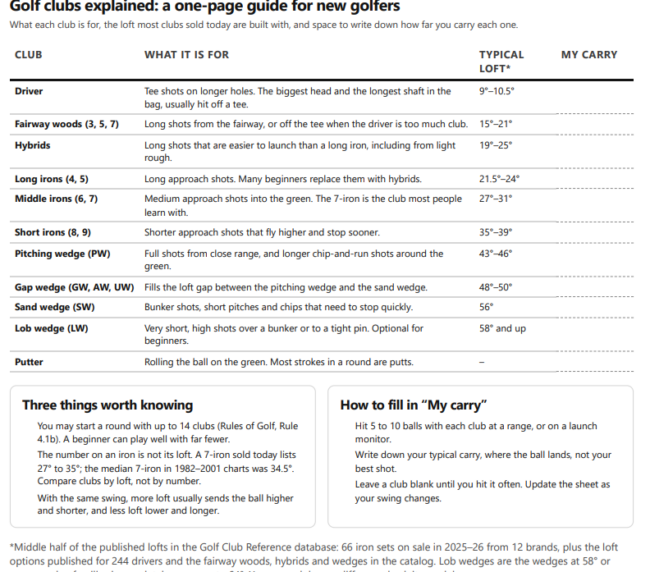
The Rules of Golf let you start a round with up to 14 clubs. A new golfer doesn’t need anywhere near that many, and most people learn faster with a short set they understand than with a full bag they’re guessing with. If you want a one-page sheet that shows what each club is for and the lofts clubs are built with today, there’s a free printable at Golf Club Reference that you can fill in as you go.
Start with Seven or Eight Clubs
The putter comes first. Most of the strokes in a round are putts, so it’s the one club you’ll use on every hole. Pick one that feels comfortable and lines up easily; it doesn’t need to be new or expensive.
Next is a sand wedge, at around 56 degrees of loft. It handles bunkers, short pitches and chips that need to stop quickly, and beginners spend a lot of time near the green. Add a pitching wedge for full shots from close range and longer chip-and-run shots. On most new sets it’s somewhere between 43 and 46 degrees.
Then two or three irons: a 7-iron and a 9-iron, or a 6, 8 and 9 if they come as a set. The 7-iron is the club most people learn with, so it’s a good one to build your swing around.
For longer shots, a 4 or 5 hybrid (roughly 19 to 25 degrees) replaces the long irons that most beginners struggle to get in the air. It’s easier to launch and works from light rough too.
Last, a fairway wood or a driver. A 5-wood or 3-wood is easier to hit for a lot of new players, and you can use it off the tee or from the fairway. Plenty of teaching pros suggest waiting on the driver until your swing is more consistent. If you do buy one, a higher loft (10.5 degrees or more) is usually more forgiving.
What Can Wait
Long irons (the 4 and 5) can wait, since hybrids do the same job with less effort. You can add them later if you find you like them.
A gap wedge, usually 48 to 50 degrees, fills the space between the pitching wedge and the sand wedge. It makes sense once you know your own distances and notice a gap you want to fill.
A lob wedge is anything 58 degrees and up, built for very high, short shots over a bunker. It’s fun to hit, but it’s also an easy club to misuse when you’re starting out.
Check The Loft, Not Just The Number
The number on an iron doesn’t tell you its loft. A 7-iron sold today lists anywhere from about 27 to 35 degrees, depending on the model. In manufacturer charts from 1982 to 2001, the median 7-iron was 34.5 degrees.
That matters if you’re buying a used set or mixing clubs from different sets. An older 7-iron can fly more like a newer 8-iron, and two 7-irons from different brands can carry very different distances, so compare clubs by loft.
Make Sure They Fit
A brand-new set that’s the wrong length is harder to learn with than a used set that fits. Taller and shorter players, and juniors, often need clubs longer or shorter than standard; if you have to stand bent over or choke way down, the club probably doesn’t fit you. Most beginners also do better with a softer shaft flex (regular, senior or ladies) than with stiff shafts. And look at the grips. Worn, slick grips make you squeeze harder, while new ones are cheap and make an old set feel much better.
If you can, try a club at the range before you buy it, or ask a pro to take a quick look at your setup.
Write Down Your Own Distances
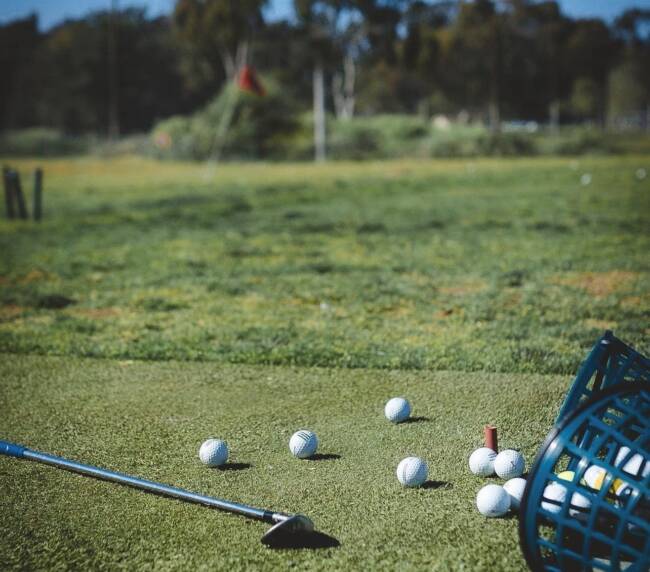
Once you have a set, take it to the range and hit 5 to 10 balls with each club. Write down your typical carry, meaning where the ball lands, not your best shot, and leave a club blank until you hit it often enough to know. Those numbers show you which club to pull on the course, and later they show you where your set has a gap when it’s time to add a club.